';
Warning: Trying to access array offset on value of type bool in /home/lphfcjvxjw/matriarchycollective.com/wp-content/plugins/bridge-core/modules/shortcodes/shortcode-elements/_portfolio-list/templates/parts/lightbox.php on line 9
zoom

Editorial

What is Matriarchy?

A New Era of Balance & Leadership

The Divine Feminine & the Power of the Mother

what is

Matriarchy

The feminine is divine. Matriarchy honors and cherishes the wisdom of the mother. Defined as “a social system in which power and authority are primarily held by women, particularly mothers and female elders, it is a social construct- a system of social organization,” matriarchy is more than a belief.

To understand what matriarchy is, we have to start where all life begins… with the mother. Every human being who has ever lived was carried and brought into existence by one. Every animal. Every creature. Every living thing that has ever existed on this earth came into being through a mother. The earth that sustains us in all ways is called Mother Earth. The mother is the origin of everything as we know it.

Matriarchy honors the divinity of the mother. Matriarchy is an ancient way of being, organized around the wisdom, the sacred power, and the divine existence of the feminine. Returning to this way of being feels less like a radical idea and more like a homecoming.

Matriarchy Through History

Across the ancient world, the divine feminine was not secondary, it was foundational. The goddess was not an abstract concept but a living presence woven into the fabric of both daily life and spiritual understanding. Temples dedicated to the goddess(s) stood at the heart of great cities. Priestesses served not as symbolic figures, but as active intermediaries between the human and the sacred. The qualities now associated with the feminine—intuition, nurturance, empathy, cooperation, and reverence for the rhythms of nature—were not diminished or dismissed. They were honored as expressions of the divine.

In ancient Egypt, the goddess was known as Isis. Isis was a figure of immense power, embodying wisdom, magic, and motherhood. Her influence was not limited to myth; she represented a worldview in which creation, protection, and transformation were inseparable from the feminine principle.

"In the beginning there was Isis: Oldest of the Old, She was the Goddess from whom all Becoming Arose. She was the Great Lady, Mistress of the two Lands of Egypt, Mistress of Shelter, Mistress of Heaven, Mistress of the House of Life, Mistress of the word of God. She was the Unique. In all Her great and wonderful works She was a wiser magician and more excellent than any other God. Thebes, Egypt, Fourteenth Century BC..."

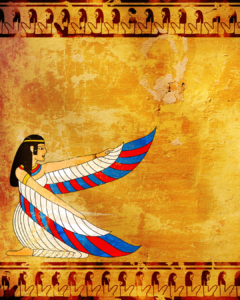
Depiction of Isis, the Egyptian goddess of wisdom and motherhood, seated with protective wings extended.

On the island of Crete, the Minoans (circa 3000 BCE) cultivated a sophisticated and notably non-militaristic society in which female deities and priestesses held central roles. Their art, architecture, and ritual life all point toward a culture deeply aligned with the sacred feminine, where power was expressed through balance rather than domination.

This structure was not an outlier.

Across the ancient Mediterranean and Near East- among the Greeks, Romans, and Persians- the feminine aspect of the divine was acknowledged and integrated into religious systems.

Among the native and indigenous cultures, the Iroquois Nation of North America offers a compelling example of matriarchal governance in practice. Clan mothers held decisive authority: they selected chiefs, guided political decisions, and ensured the continuity of cultural values. These societies were neither primitive nor marginal; they were structured, enduring, and deeply attuned to principles of relational balance and collective responsibility.

“In the world’s oldest creation myths, the female god creates the world out of her own body. The Great Mother everywhere was the active and autonomous creatrix of the world . . . and, unlike the aloof and self-righteous patriarchal gods who only recently usurped her mountain-throne, the ancient Goddess was always there—alive, immanent—within her creation; no ontological scapegoater, she was wholly responsible for both the pain and the good of life.”

As patriarchy rose into prominence, the goddess was dethroned. Women’s sacred authority was systematically diminished, their stories rewritten or erased entirely, their power reframed as dangerous. What had once been honored and revered became feared. What had once been central became hidden.

But it was never fully extinguished.

Sophia- rooted in the Hebrew tradition and present throughout the Old Testament as the embodiment of divine wisdom-  was slowly reduced to a footnote as patriarchal religion took hold. Within Gnostic traditions she is understood as a cosmic force, the feminine aspect of the divine itself, the soul of the world, the wisdom that existed before creation. She was not a peripheral figure. She was foundational. And yet her story, like so many stories of women’s sacred power, was pushed to the margins of mainstream religious history.

Within the Christian tradition, Mary Magdalene- misrepresented for centuries as a penitent sinner- is increasingly being reclaimed as something far more significant. Scholars, spiritual seekers, and historians alike are returning to the evidence that she was a leader, a teacher, and one of the most important figures in early Christian history. She carried wisdom. She carried authority. She carries the divine flame of the Christ.

And then there is Mary, the Mother- relegated and reduced to her virginity, as though only by being stripped of her full womanhood could she be deemed worthy, by a patriarchal tradition, to have birthed the divine. The pattern is unmistakable. Within that tradition, a woman is either virgin or whore. The fullness of the feminine- her power, her wisdom, her sacred authority – has no place in modern tradition.

This reemergence in modern spiritual consciousness is no coincidence. It is part of a much larger reclamation- a collective remembering of what was lost, suppressed, and deliberately hidden. The divine feminine did not disappear. She went underground, carried quietly through centuries in secret traditions, in the hands of healers and wisdom keepers, in the hearts of those who never stopped knowing her.
And now she ascends again- within all of us who honor the feminine as divine.


“Our culture's official rejection of the Crone figure was related to rejection of women, particularly elder women. The gray-haired high priestesses, once respected tribal matriarchs of pre-Christian Europe, were transformed by the newly dominant patriarchy into minions of the devil. Through the Middle Ages, this trend gathered momentum, finally developing a frenzy that legally murdered millions of elder women from the twelfth to the nineteenth centuries.”

The Sacred Feminine at the Heart of Matriarchy

To understand the relationship between matriarchy and the divine feminine, it helps to understand what makes them distinct and what makes them inseparable.

The divine feminine is internal; a quality of being. It is the nurturing, intuitive, creative, and receptive energy that lives within every person regardless of gender. It is Shakti, the primordial feminine force of the Hindu tradition, the dynamic power that animates all of creation. It is Pachamama, the living earth mother of Andean indigenous tradition, the embodiment of nature’s generosity and cycles. It is the part of us that feels before it thinks, that creates before it calculates, that tends to life rather than seeking to conquer it.

Matriarchy is that same truth made visible in the world. It is the external structure- the social construct- that emerges when a society organizes itself around those values. When the divine feminine moves from the interior life of the individual into the architecture of how we live together, matriarchy is what that looks like.

They are not the same thing; but they are not separate either. The divine feminine is the seed. Matriarchy is what grows when that seed is given the conditions to flourish.

This distinction matters because it means that the reclamation of the divine feminine is not only a political or social project- it is a deeply personal one. It begins within. It begins with the individual recognition that feminine wisdom, feminine ways of knowing, and feminine values are not lesser than their masculine counterparts. They are sacred. They are necessary. And they have been systematically devalued in ways that have cost all of us- men and women alike- something profound.

A matriarchal world is not a world where women dominate men. That would simply be patriarchy with a prettier face. It is a world where the qualities of the divine feminine- empathy, cooperation, reverence for life, and the wisdom of the mother- are honored at every level of human organization. In the home. In the community. In governance. In the way we relate to the earth herself.

The divine feminine and matriarchy are, at their deepest level, two expressions of the same sacred truth- that life is mothered into being, that the feminine is the source, and that a world which honors that truth is a world more whole than the one we have inherited.

“The image of the Goddess inspires women to see ourselves as divine, our bodies as sacred, the changing phases of our lives as holy, our aggression as healthy, our anger as purifying, and our power to nurture and create, but also to limit and destroy when necessary, as the very force that sustains all life. Through the Goddess, we can discover our strength, enlighten our minds, own our bodies, and celebrate our emotions. We can move beyond narrow, constricting roles and become whole.”

Why Matriarchy Matters Today

Something is shifting. Most can feel it, even if they can’t name it- a growing awareness across cultures, generations, and different walks know that the world is out of balance. The systems we have inherited are no longer serving us. Something fundamental is ready to change.

This feeling is not pessimism. It is perception. We cannot begin to find solutions until we are willing to recognize the problem-and that recognition is underway. It is the dawning of a powerful awakening.

More and more people are turning toward the values that matriarchy has always centered- cooperation over competition, care over conquest, wisdom over power- not as a political stance, but as a deeper way of being. It is a recognition that the path forward is remembering who and what we really are.

“The symbolism of the Goddess is not a parallel structure to the symbolism of God the Father. The Goddess does not rule the world; She is the world. Manifest in each of us, She can be known internally by every individual, in all her magnificent diversity.”

Community, by its very nature, reflects matriarchal principles. It is built on nurturing, cooperation, and mutual care- the very qualities the feminine embodies. History points to this truth: communities shaped by strong female leadership tend toward more peaceful resolution, more balanced distribution of resources, and a deeper respect for the natural world.

The return of the divine feminine is not a passing cultural moment. It is a course correction- a collective focusing towards the values that sustain life and that will improve all of our lives for the better. It is the prioritizing of mutual care, wisdom, cooperation, and reverence for what is sacred. These are not new ideas, they have existed across cultures for eons.

Matriarchy matters today because the wisdom of the mother is not a relic of the past, it is a spiritual force and a way to better our lives of not only ourselves but those we love most. The mother has endured centuries of suppression, yet it remains true. To remember it now is not to look backward, but to move forward with intention. It is to build a world shaped by the essence of the nurturer, with the essence of the mother at its core.

A Closing Invitation

Matriarchy and the divine feminine are not abstract ideas or distant points in history. They are how we show up in the world-  in the instinct to nurture, in the choice to listen, in valuing connection over control. They are present whenever we extend care, seek wisdom, and offer mutual respect in how we relate to one another. In that sense, they are not something outside of us. They are something we embody.

The Matriarchy Collective exists as a space for that wisdom and knowledge- for those who are just beginning to explore these ideas, and for those who have long felt them but are now seeking language, context, or community around them. This is a place for reflection, learning, and shared understanding.

This is not a conclusion so much as a beginning. There is more to explore- more history, more voices, more ways of understanding what it means to live in balance. The path forward is not only about creating something new, but about remembering what has always been there, waiting to be honored again.

Wherever you are on your journey, all seekers are welcome here.